
[](https://crates.io/crates/xiu)
[](https://crates.io/crates/xiu)
[](https://crates.io/crates/rtmp)
[](https://crates.io/crates/rtmp)
[](https://crates.io/crates/xrtsp)
[](https://crates.io/crates/xrtsp)
[](https://crates.io/crates/xwebrtc)
[](https://crates.io/crates/xwebrtc)
[](https://crates.io/crates/httpflv)
[](https://crates.io/crates/httpflv)
[](https://crates.io/crates/hls)
[](https://crates.io/crates/hls)
[](https://crates.io/crates/xflv)
[](https://crates.io/crates/xflv)
[](https://crates.io/crates/xmpegts)
[](https://crates.io/crates/xmpegts)
[](https://app.travis-ci.com/github/harlanc/xiu)
[](https://discord.gg/gS5wBRtpcB)

[中文文档](https://github.com/harlanc/xiu/blob/master/README_CN.md)
Xiu is a simple,high performance and secure live media server written in pure Rust, it now supports popular live protocols like RTMP[cluster]/RTSP/WebRTC[Whip/Whep]/HLS/HTTP-FLV.
## Features
- [x] Support multiple platforms(Linux/MacOS/Windows).
- [x] Support RTMP.
- [x] Support publishing or subscribing H.264/AAC streams.
- [x] Support GOP cache which can be configured in the configuration file.
- [x] Support protocol conversion from RTMP to HTTP-FLV/HLS.
- [x] Support cluster.
- [x] Support RTSP.
- [x] Support publishing or subscribing H.265/H.264/AAC stream over both TCP(Interleaved) and UDP.
- [x] Support protocol conversion from RTSP to RTMP/HLS/HTTP-FLV.
- [x] Support WebRTC(Whip/Whep).
- [x] Support publishing rtc stream using Whip.
- [x] Support subscribing rtc stream using Whep.
- [x] Support HTTP-FLV/HLS protocols(Transferred from RTMP/RTSP).
- [x] Support configuring the service using command line or a configuration file.
- [x] Support HTTP API/Notifications.
- [x] Support querying stream information.
- [x] Support notification of stream status.
- [x] Support token authentications.
- [x] Support recording live streams into HLS files(m3u8+ts).
## Preparation
#### Install Rust and Cargo
[Document](https://doc.rust-lang.org/cargo/getting-started/installation.html)
## Install and run
There are two ways to install xiu :
- Using cargo to install
- Building from source
### Install using cargo
Issue the following command to install xiu:
cargo install xiu
Start the service with the following command to get help:
xiu -h
A secure and easy to use live media server, hope you love it!!!
Usage: xiu [OPTIONS]
Options:
-c, --config Specify the xiu server configuration file path.
-r, --rtmp Specify the RTMP listening port(e.g.:1935).
-t, --rtsp Specify the rtsp listening port.(e.g.:554).
-w, --webrtc Specify the whip/whep listening port.(e.g.:8900).
-f, --httpflv Specify the HTTP-FLV listening port(e.g.:8080).
-s, --hls Specify the HLS listening port(e.g.:8081).
-l, --log Specify the log level. [possible values: trace, debug, info, warn, error, debug]
-h, --help Print help.
-V, --version Print version.
### Build from souce
#### Clone Xiu
git clone https://github.com/harlanc/xiu.git
use master branch
#### Build
We use makefile to build xiu and revelant libraries.
- Using make local to build local source codes:
make local && make build
- Using make online to pull the online crates codes and build:
make online && make build
#### Run
cd ./xiu/target/release or ./xiu/target/debug
./xiu -h
## CLI
#### Instructions
You can use command line to configure the xiu server easily. You can specify to configure xiu using configuration file or from the command lines.
##### Configure using file
xiu -c configuration_file_path
##### Configure using command line
xiu -r 1935 -t 5544 -f 8080 -s 8081 -l info
#### How to Configure the configuration file
##### RTMP
[rtmp]
enabled = true
port = 1935
# pull streams from other server node.
[rtmp.pull]
enabled = false
address = "192.168.0.1"
port = 1935
# push streams to other server node.
[[rtmp.push]]
enabled = true
address = "localhost"
port = 1936
[[rtmp.push]]
enabled = true
address = "192.168.0.3"
port = 1935
##### RTSP
[rtsp]
enabled = false
port = 5544
##### WebRTC(Whip/Whep)
[webrtc]
enabled = false
port = 8900
##### HTTPFLV
[httpflv]
# true or false to enable or disable the feature
enabled = true
# listening port
port = 8081
##### HLS
[hls]
# true or false to enable or disable the feature
enabled = true
# listening port
port = 8080
# need record the live stream or not
need_record = true
##### Log
[log]
level = "info"
[log.file]
# write log to file or not(Writing logs to file or console cannot be satisfied at the same time).
enabled = true
# set the rotate
rotate = "hour" #[day,hour,minute]
# set the path where the logs are saved
path = "./logs"
### Configuration examples
I edit some configuration files under the following path which can be used directly:
xiu/application/xiu/src/config
It contains the following 4 files:
config_rtmp.toml //enable rtmp only
config_rtmp_hls.toml //enable rtmp and hls
config_rtmp_httpflv.toml //enable rtmp and httpflv
config_rtmp_httpflv_hls.toml //enable all the 3 protocols
## Scenarios
##### Push
###### Push RTMP
You can use two ways:
- Use OBS to push a live rtmp stream
- Or use FFmpeg to push a rtmp stream:
ffmpeg -re -stream_loop -1 -i test.mp4 -c:a copy -c:v copy -f flv -flvflags no_duration_filesize rtmp://127.0.0.1:1935/live/test
###### Push RTSP
- Over TCP(Interleaved mode)
ffmpeg -re -stream_loop -1 -i test.mp4 -c:v copy -c:a copy -rtsp_transport tcp -f rtsp rtsp://127.0.0.1:5544/live/test
- Over UDP
ffmpeg -re -stream_loop -1 -i test.mp4 -c:v copy -c:a copy -f rtsp rtsp://127.0.0.1:5544/live/test
###### Push RTC(Whip)
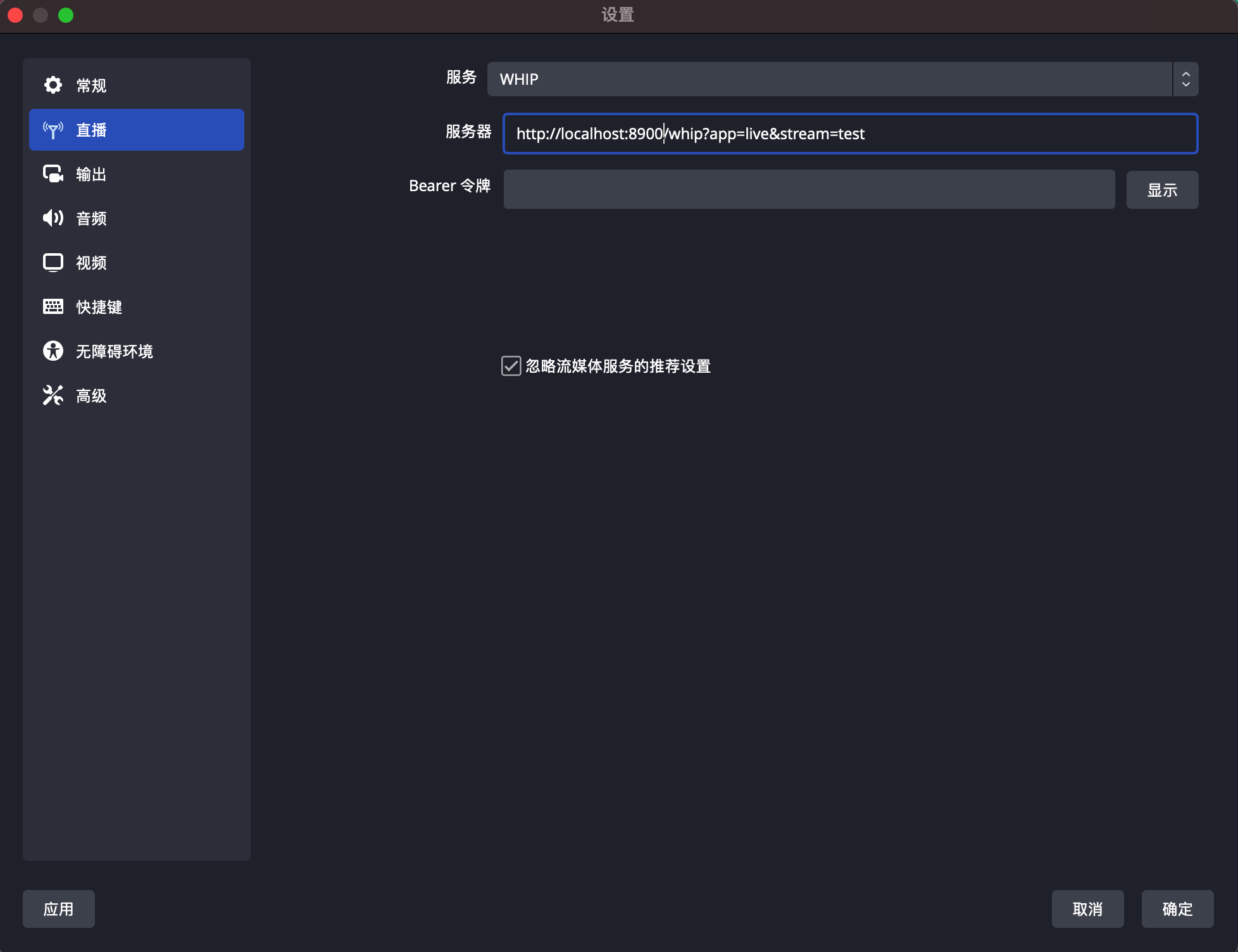
Now OBS (version 3.0 or above) can support whip output. The configurations are as follows:
##### Play
Use ffplay to play the rtmp/rtsp/httpflv/hls live stream:
ffplay -i rtmp://localhost:1935/live/test
ffplay -i rtsp://127.0.0.1:5544/live/test
ffplay -rtsp_transport tcp -i rtsp://127.0.0.1:5544/live/test
ffplay -i http://localhost:8081/live/test.flv
ffplay -i http://localhost:8080/live/test/test.m3u8
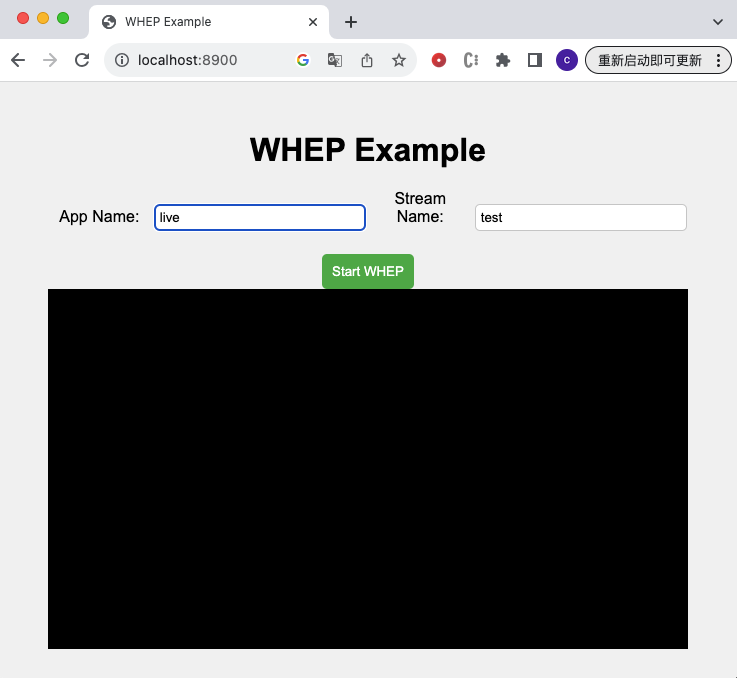
- How to play WebRTC stream*(Whep)
1. Copy the files under xiu/protocol/webrtc/src/clients/ folder to the same level directory of the binary file xiu.
2. Open the address http://localhost:8900 in the browser.
3. Enter the app name and stream name corresponding to the OBS whip publish address.
4. Click Start WHEP(After OBS publish) to play the RTC stream.
##### Relay - Static push
The configuration files are as follows:
The configuration file of Service 1 named config.toml:
[rtmp]
enabled = true
port = 1935
[[rtmp.push]]
enabled = true
address = "localhost"
port = 1936
The configuration file of Service 2 named config_push.toml:
[rtmp]
enabled = true
port = 1936
Run the 2 services:
./xiu config.toml
./xiu config_push.toml
Use the above methods to push rtmp live stream to service 1, then the stream can be pushed to service 2 automatically, you can play the same live stream from both the two services:
ffplay -i rtmp://localhost:1935/live/test
ffplay -i rtmp://localhost:1936/live/test
##### Relay - Static pull
The configuration file are as follows:
The configuration file of Service 1 named config.toml:
[rtmp]
enabled = true
port = 1935
The configuration file of Service 2 named config_pull.toml:
[rtmp]
enabled = true
port = 1936
[rtmp.pull]
enabled = false
address = "localhost"
port = 1935
Run the 2 services:
./xiu config.toml
./xiu config_pull.toml
Use the above methods to push live stream to service 1, when you play the stream from serivce 2, it will pull the stream from service 1:
ffplay -i rtmp://localhost:1935/live/test
ffplay -i rtmp://localhost:1936/live/test
## Star History
[](https://star-history.com/#harlanc/xiu)
## Thanks
- [media_server](https://github.com/ireader/media-server.git)
## Others
Open issues if you have any problems. Star and pull requests are welcomed. Your stars can make this project go faster and further.